2.1.async_model
2. Asynchronous Model
- Boost.Asio library's asynchronous model enshrines asynchronous operations as the fundamental building block of asynchronous composition, but in a way that decouples them from the composition mechanism.
- The asynchronous operations in Boost.Asio support
- callbacks,
- futures (both eager and lazy),
- fibers,
- coroutines, and
- ...
- This allows the application programmer to select an approach based on appropriate trade-offs.
Asynchronous Operations
- An asynchronous operation is the basic unit of composition in the Boost.Asio asynchronous model.
- Asynchronous operations represent work that is launched and performed in the background, while the user's code that initiated the work can continue with other things.
- Conceptually, the lifecycle of an asynchronous operation can be described in terms of the following events and phases:
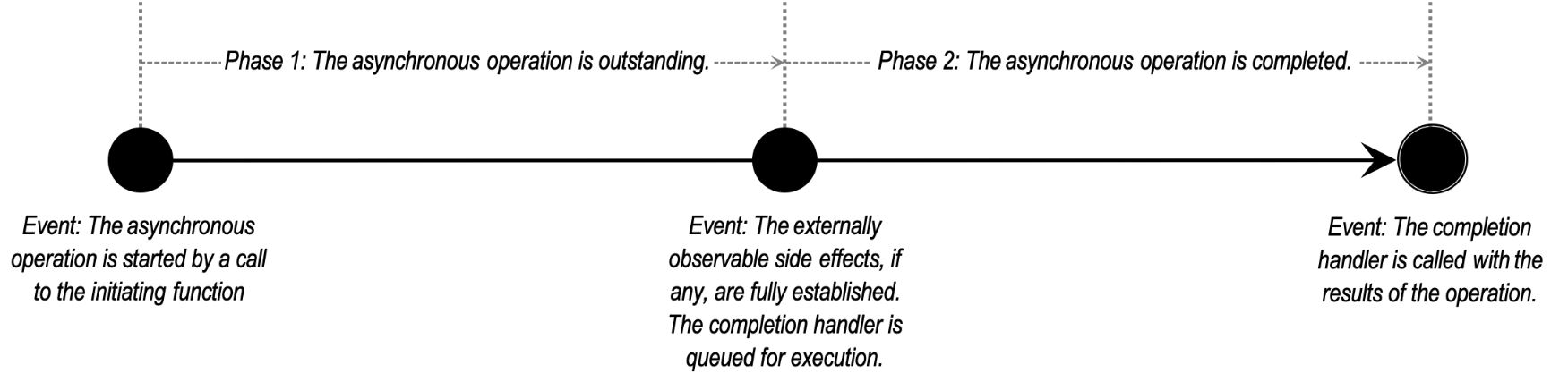
- An initiating function is a function which may be called by the user to start an asynchronous operation.
- A completion handler is a
- user-provided,
- move-only function object that will be invoked, at most once, with the result of the asynchronous operation.
- The invocation of the completion handler tells the user about something that has already happened: the operation completed, and the side effects of the operation were established.
Synchronous operations, being embodied as single functions, have several inherent semantic properties as a consequence.
- Asynchronous operations adopt some of these semantic properties from their synchronous counterparts, in order to facilitate flexible and efficient composition.
| Property of synchronous operations | Equivalent property of asynchronous operations |
|---|---|
| When a synchronous operation is generic (i.e. a template) the return type is deterministically derived from the function and its arguments. | When an asynchronous operation is generic, the completion handler's arguments' types and order are deterministically derived from the initiating function and its arguments. |
| If a synchronous operation requires a temporary resource (such as memory, a file descriptor, or a thread), this resource is released before returning from the function. | If an asynchronous operation requires a temporary resource (such as memory, a file descriptor, or a thread), this resource is released before calling the completion handler. |
The latter is an important property of asynchronous operations, in that
- it allows a completion handler to initiate further asynchronous operations without overlapping resource usage.
Consider the trivial (and relatively common) case of the same operation being repeated over and over in a chain. By ensuring that resources are released before the completion handler runs, we avoid doubling the peak resource usage of the chain of operations.