belle_views_on_cpp_ranges
Belle Views on C++ Ranges, their Details and the Devil - Nico Josuttis
What is possible? Init a range with random numbers
- Pre C++20
template <typename T>
void randomAdd(T& vals) {
  std::default_random_engine dre{std::random_device{}()};
  std::uniform_int_distribution<int> random{1, 99};
  for (auto& v : vals) {
    v += random(dre);
  }
}

std::vector<int> coll(8);
randomAdd(coll);- first few change with C++20
void randomAdd(auto& vals) { // since C++20
  std::default_random_engine dre{std::random_device{}()};
  std::uniform_int_distribution random{1, 99}; // auto deduction of type
  for (auto& v : vals) {
    v += random(dre);
  }
}- Problem, imagine you do this.
queuehas no begin and end, so it can't do the range for.
std::queue<int> q;
randomAdd(q); // ERROR with some terrible messages!
C++20: Concepts as type constraints
void randomAdd(std::ranges::forward_range auto& vals) { // since C++20
  //.. same above
}

std::queue<int> q;
randomAdd(q); // ERROR: constraint forward_range not satisfied- but then, what if we do:
std::vector<std::string> words = { "tic", "tac", "toe" };
randomAdd(words); // It CAB compile!!!
// but a random char might be added to the end of string- So we can expand our constraint as such:
void randomAdd(std::ranges::forward_range auto& vals)
requires std::integral<typename decltype(vals)::value_type>> {
  //.. same above
}- Seems right, but you somehow get an error when you pass in
std::vector<int>now. Why?- Because
std::vector<int>&::value_typeis not valid! - So we need to do ....
- Because
void randomAdd(std::ranges::forward_range auto& vals)
requires std::integral<typename std::remove_cvref_t<decltype(vals)>::value_type>> {
  //.. same above
}- Can we do better? Maybe
autois not the best idea here. Go back to template...
template <typename RgT>
void randomAdd(Rgt& vals)
requires std::ranges::forward_range<RgT> &&
         std::integral<typename RgT::value_type> {
  //.. same as above
}- Or maybe, we could:
template <std::ranges::forward_range RgT>
void randomAdd(Rgt& vals)
requires std::integral<typename RgT::value_type> {
  //.. same as above
}- But what if ...
int data[] = {1, 2, 3}; // no value_type for raw array
randomAdd(data);- We can do this to overcome
template <std::ranges::forward_range RgT>
void randomAdd(Rgt& vals)
requires std::integral<std::ranges::range_value_t<RgT>> {
  //.. same as above
}- You can also use above snippet for thread, and plus few C++20 features, you can make it do the right thing.
template <std::ranges::forward_range RgT>
void randomAdd(Rgt& vals)
requires std::integral<std::ranges::range_value_t<RgT>> {
  auto init = [&](std::stop_token st) {
    std::default_random_engine dre{std::random_device{}()};
    std::uniform_int_distribution random{1, 99};
    for (auto& v : vals) {
      if (st.stop_requested()) return;
      std::atomic_ref{v} += random(dre); // v is atomic only in this context
    }
  };
  std::vector<std::jthread> threads;
  for (int i = 0; i < 4; ++i) {
    threads.push_back(std::jthread{init});
  }

  /*
  // implicit by jthread destructor
  for (auto& t : threads) {
    t.request_stop();
    t.join();
  } */
}

std::vector<int> coll(8);
randomAdd(coll);std::jthread,std::stop_token(since C++20)- Unlike
std::thread, thejthreadlogically holds an internal private member of typestd::stop_source, which maintains a shared stop-state. - The
jthreadconstructor accepts a function that takes astd::stop_tokenas its first argument, which will be passed in by the jthread from its internalstd::stop_source. This allows the function to check if stop has been requested during its execution, and return if it has.
- Unlike
std::atomic_ref: For the lifetime of the atomic_ref object, the object it references is considered an atomic object. If one thread writes to an atomic object while another thread reads from it, the behavior is well-defined
C++ 20 views
std::vector<int> vec(8);
auto v = vec | std::views::take(5);
randomAdd(v);
print(vec2); // could give us 251 267 358 159 266 0 0 0


std::list<int> lst(8);
auto l = lst | std::views::drop(2) | std::views::take(5);
randomAdd(l);
print(lst); // could give us 0 0 156 161 240 108 123 0

// If you add a print of to show the size of input range in randomAdd
// std::cout << std::ranges::size(vals) << '\n';
// the result would have been 5 and 5-
The cool thing of views above is well understood by the unix folks. We know the power of using little building blocks to create really interesting complex stuff.
-
Ok, above all looks nice, but what if you do...
auto gt0 = [](const auto& val) { return val > 0; };
auto l2 = lst | std::views::filter(gt0);
randomAdd(l2);- Now the compiler will error, and complaining there is no
std::ranges::size(vals)... why?
How expensive is view's begin()?
- The
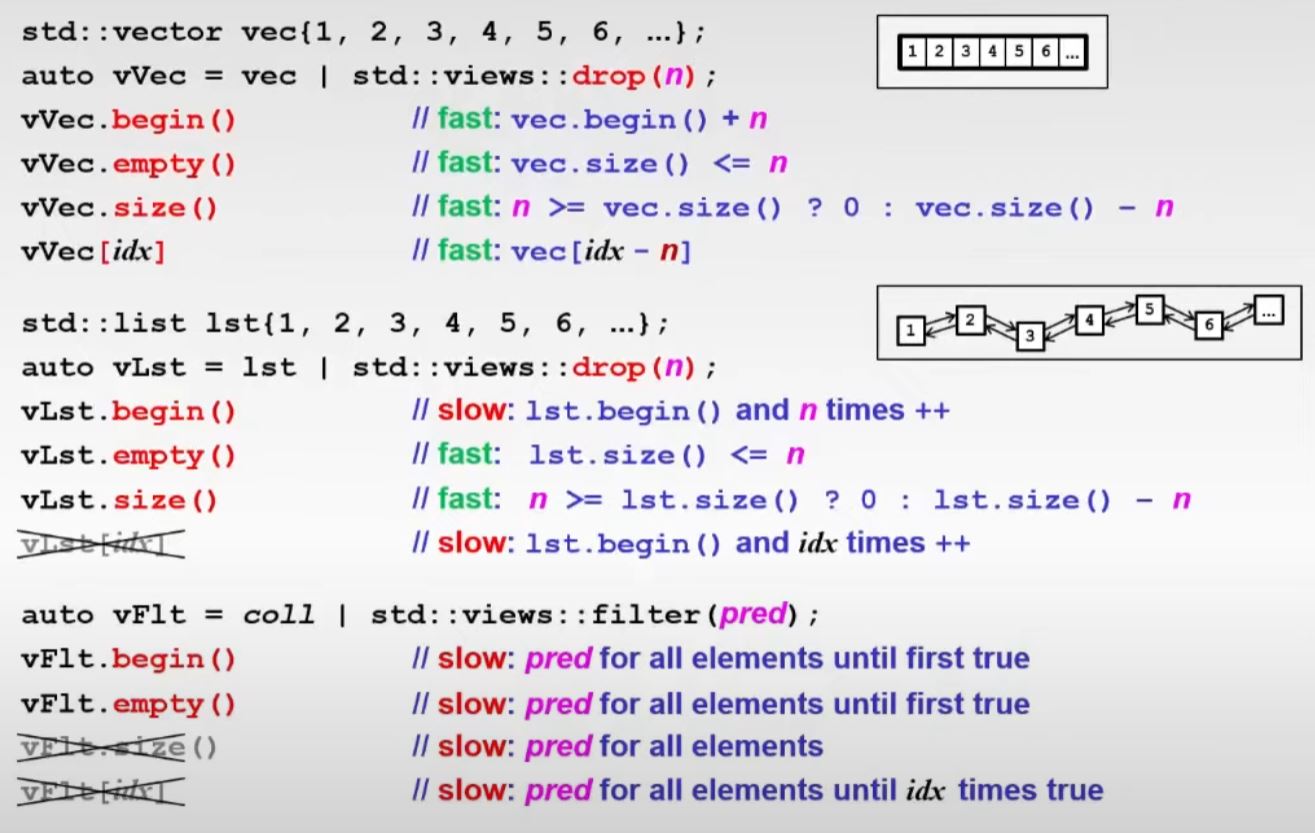
beginofdropview ofvectoris O(1) - But the
beginofdropview oflistis O(n)
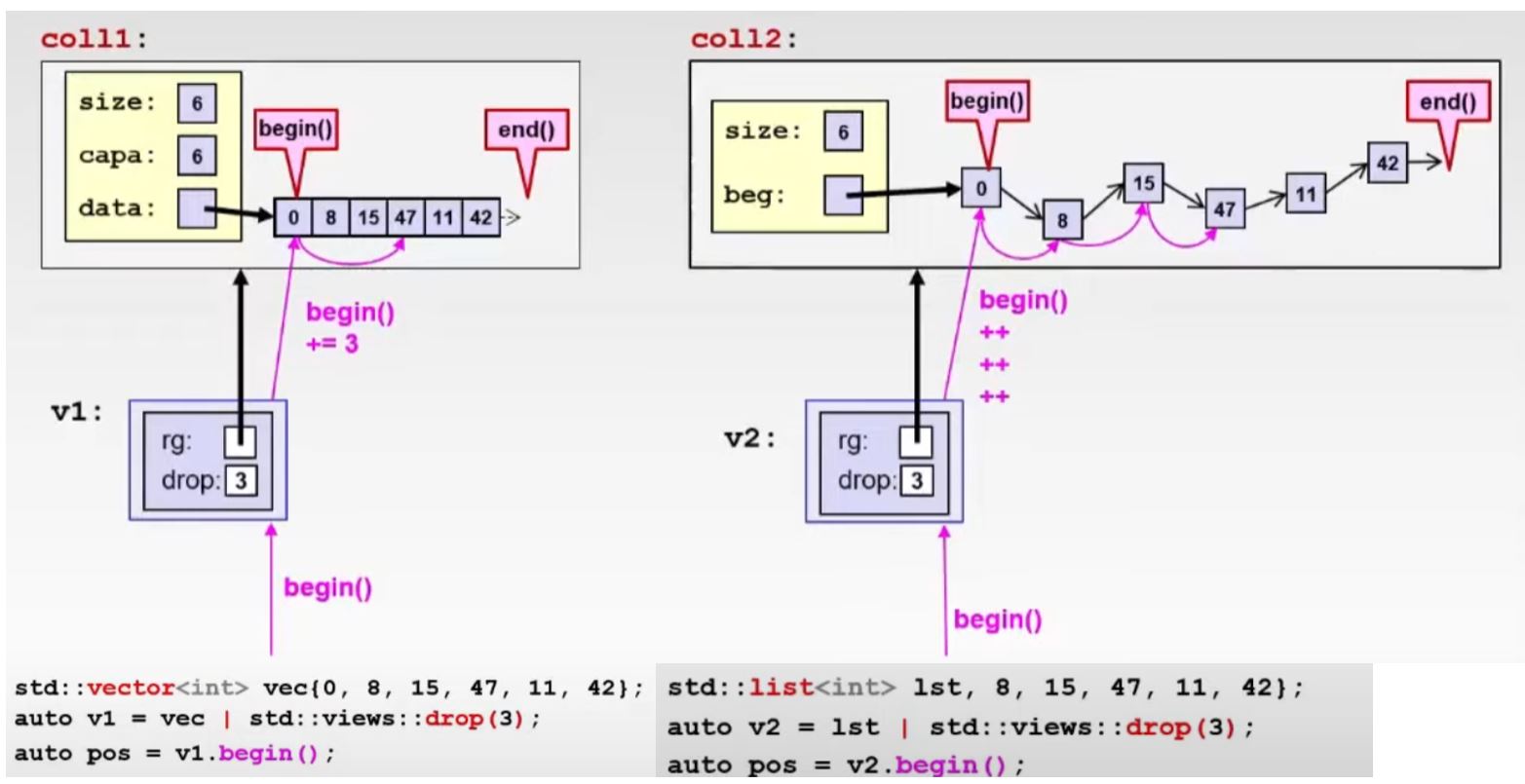
- Also think about the operations for
filter...lots of operations are basically O(n) because you need to find thebeginwhere thepredis true.
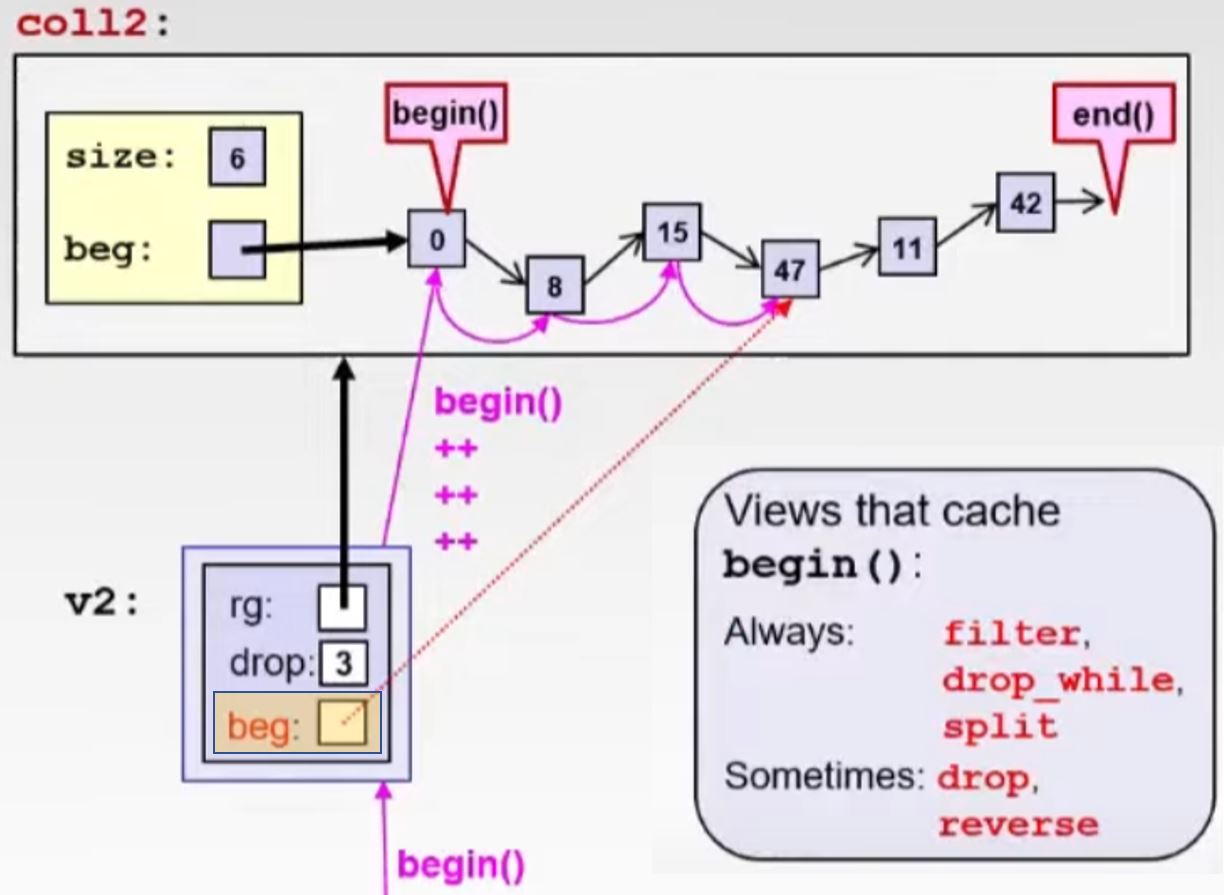
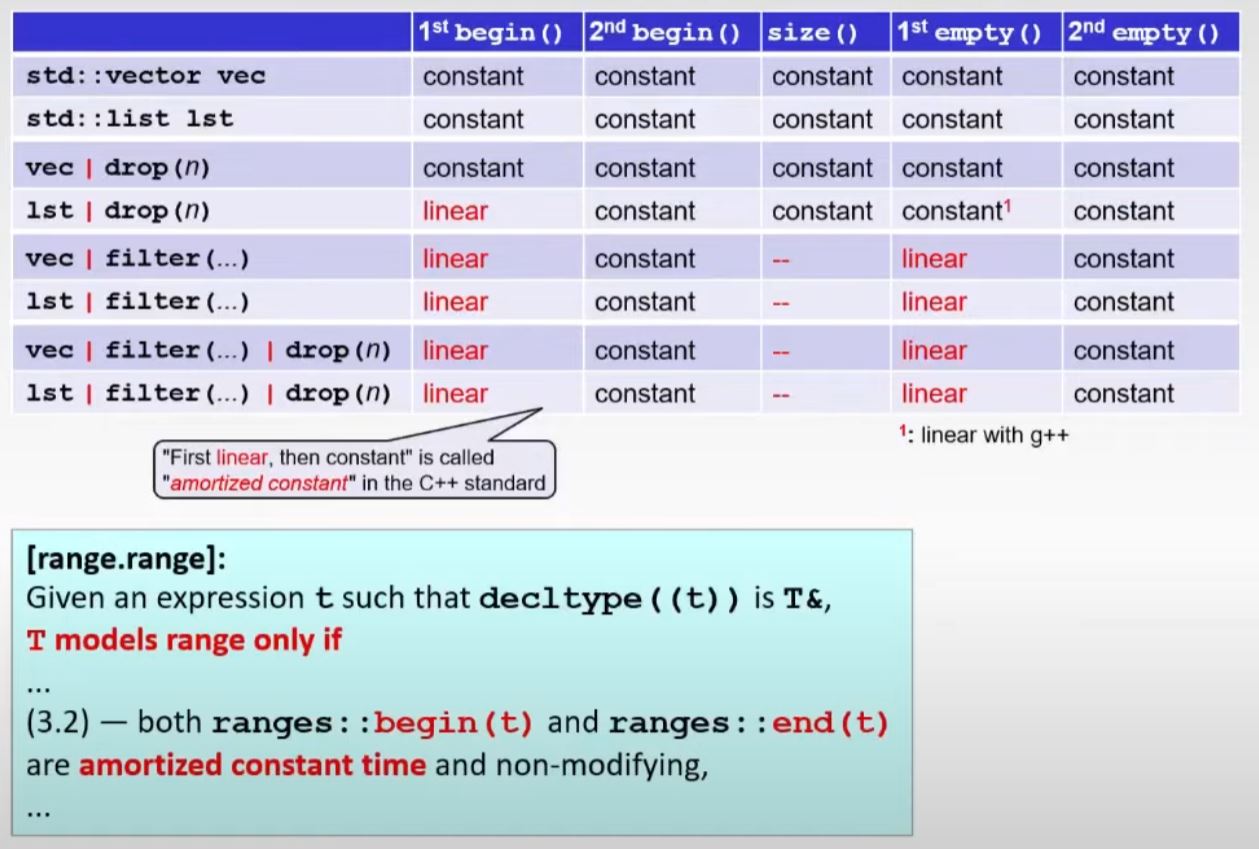
The improvement done in the library: cache begin()
- A lazy cache of the
begin()(e.g. stored when it got called the first time) - Only when it's needed, like there is no random access.
====tmp@31:09====