C++ Memory Model: from C++11 to C++23 - Alex Dathskovsky
Compiler Optimizations
Loop Unrolling: Compilers may unroll loops to reduce the overhead of loop control and increase the instruction pipeline's efficiency.
Dead Code Elimination: Compilers can remove code that does not affect the program's outcome, improving runtime performance.
Constant Expression Evaluation: Compilers evaluate constant expressions at compile time, reducing runtime computations.
Vectorization: Modern compilers can utilize SIMD (Single Instruction, Multiple Data) instructions to process data in parallel, significantly speeding up operations on arrays and vectors.
CPU Optimizations
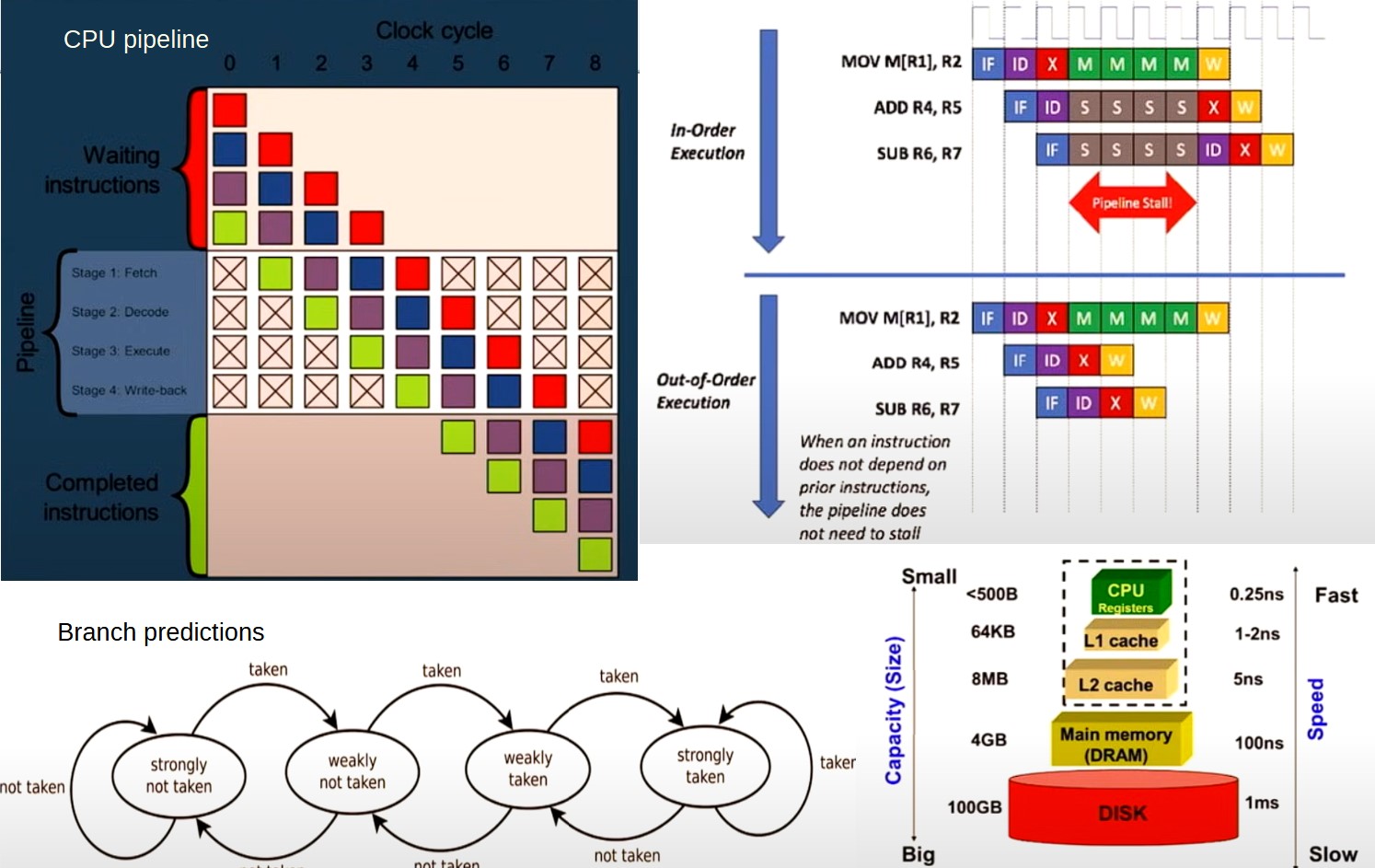
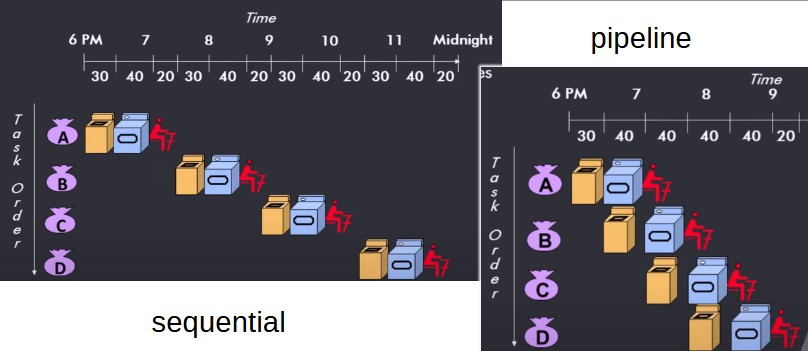
Pipelines: Modern CPUs use instruction pipelines to execute multiple instructions concurrently, improving throughput.
Branch Prediction: CPUs predict the direction of branches (if/else statements) to maintain the instruction pipeline's flow, reducing stalls caused by branch instructions.
Out-of-Order Execution: CPUs can execute instructions out of their original order to keep the pipeline filled, improving utilization of execution units.
Memory Model and Caching
Memory Hierarchy: The closer a cache is to the CPU (e.g., L1, L2), the faster the access but smaller the size. Efficient use of cache can dramatically speed up program execution.
Cache-Friendly Algorithms: Algorithms designed to make optimal use of the cache can significantly reduce memory access times and improve overall performance.
Writing Efficient Code
Understanding these concepts is crucial for developers, especially when performance is a key concern. Some strategies for writing efficient code include:
Minimizing Data Dependencies: Reducing dependencies between data and instructions can help avoid stalls in out-of-order execution.
Reducing Branches: Simplifying control flow and reducing the number of branches can minimize the impact of branch mispredictions.
Optimizing Memory Access Patterns: Accessing memory in a predictable and sequential pattern can enhance cache utilization.
Reordering and C++
Compiler Optimizations and the "As-If" Rule
"As-If" Rule: The compiler can reorder, optimize, or elide code as long as the observable behavior of the program remains unchanged. This rule allows compilers to make significant optimizations for performance.
Limitations: Certain operations, like those involving volatile variables or external libraries, must maintain their order to preserve program correctness.
Multi-Threading and Sequential Consistency
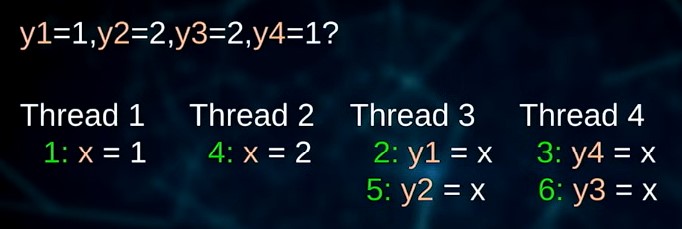
Sequential Consistency: A desired property where operations in a multi-threaded program appear to execute in some sequential order, with operations from each thread appearing in the order specified by the program.
Reality Check: Achieving true sequential consistency can be expensive and is not guaranteed by compilers or CPU architectures due to optimizations like reordering and out-of-order execution.
Synchronization and Sequential Consistency for Data Race Free (SCDRF)
Data Races: Occur when two threads access the same variable concurrently, and at least one of the accesses is a write, without proper synchronization.
SCDRF: A guarantee that if a program is free of data races, it will behave as if it is sequentially consistent. This requires the use of proper synchronization mechanisms provided by the language, such as mutexes in C++.
Example Scenarios
Thread Synchronization: Demonstrated through a theoretical example with a magical CPU instruction S, emphasizing the importance of synchronization points (happened before relationship) to ensure correct data sharing between threads.
Implications for Developers
Awareness of Optimizations: Developers must be aware of how compiler optimizations and CPU execution strategies can affect multi-threaded program behavior.
Correct Synchronization: Proper use of synchronization mechanisms is crucial to avoid data races and ensure program correctness in a concurrent execution environment.
Understanding Memory Models: Knowledge of the C++ memory model and the guarantees it provides is essential for writing correct and efficient multi-threaded code.
Synchronization
Misuse of volatile for Synchronization
Common Misconception: There's a widespread misunderstanding that the volatile keyword can be used as a synchronization tool in multi-threading contexts.
Actual Purpose of volatile: It informs the compiler not to optimize away or reorder access to the variable it decorates, ensuring that every read and write to a volatile variable is executed as written in the source code. However, it does not provide any guarantees about atomicity or ordering between threads.
Limitations: volatile variables do not prevent the CPU from reordering reads and writes, making them unsuitable for ensuring thread-safe access to shared data. Moreover, operations on volatile variables can still be reordered with respect to other memory operations.
True Synchronization Mechanisms
Memory Fences: Also known as memory barriers, these are low-level synchronization primitives that prevent certain kinds of reordering of memory operations around the fence. While powerful, writing manual memory fences is error-prone and generally discouraged in favor of higher-level abstractions.
Atomics and Locks: C++ provides atomic operations and various locking mechanisms (e.g., std::mutex, std::atomic) that are designed to ensure safe access to shared data between threads. These constructs offer guarantees about memory ordering and atomicity that are essential for writing correct concurrent code.
Compiler Support: Modern C++ compilers and the language standard provide built-in support for these synchronization primitives, making them portable and efficient across different platforms and CPU architectures.