The Hidden Performance Price of C++ Virtual Functions - Ivica Bogosavljevic
How virtual functions work?
C++ standard doesn't mandate implementation of virtual functions
Most compilers, however, implement virtual functions in a similar manner
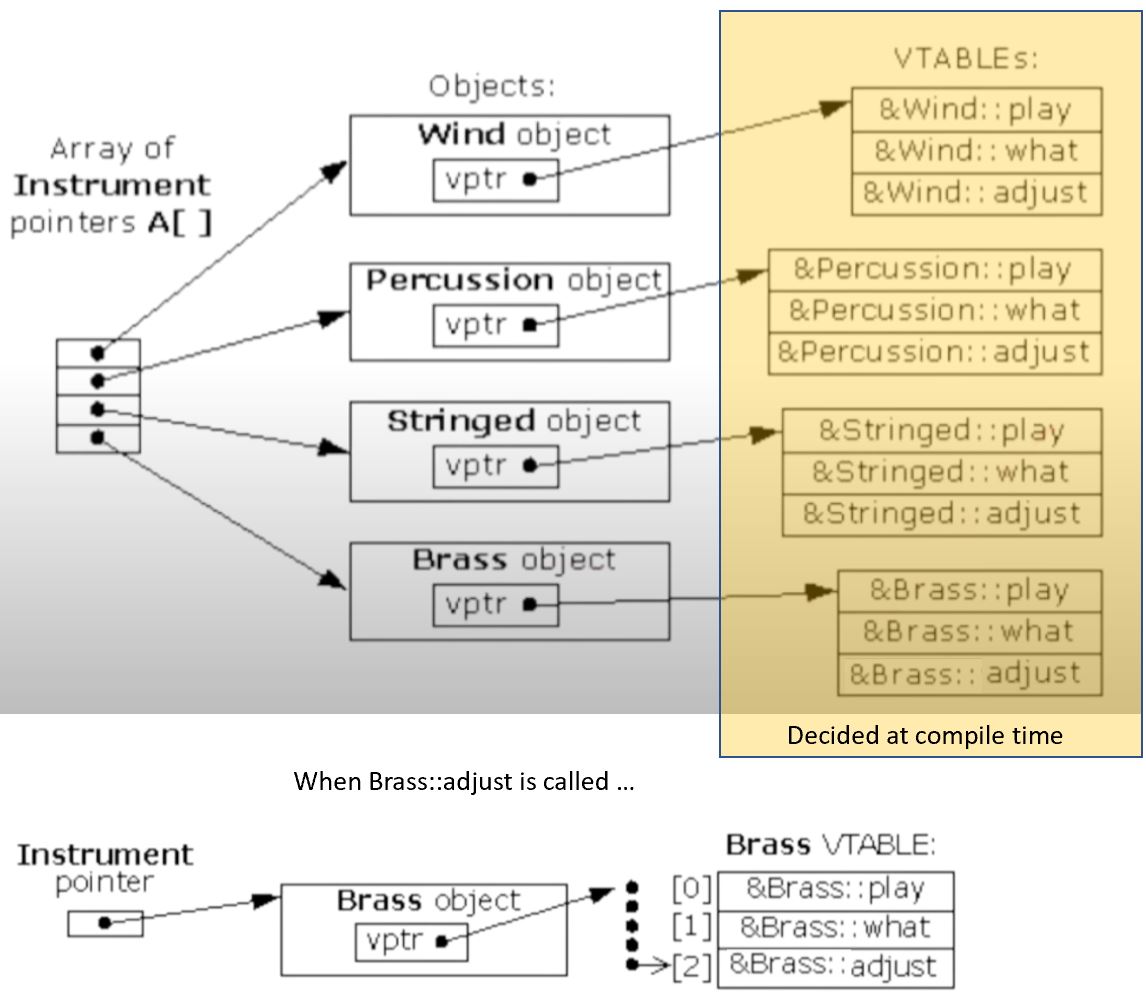
Base class Instrument, and derived classes Wind, Percussion, ...
VTable is a table attached to each type at compile time.
At run time, inside each object instance, there is a pointer vptr which points to the corresponding virtual table.
When a virtual function is called at runtime, program access the virtual pointer vptr of the object, dereference it, find the corresponding VTable to get the address of the virtual function, and then it calls the virtual function. (On the other hand, non-virtual function's address is just known at compile time so will be called right away.)
Issue 1: Virtual is slow because its mechanism
The virtual function's address is not known at compile time.
The program needs to look up the virtual function's address at runtime.
Virtual function's address lookup is done through virtual table pointer.
Issue 2: memory layout is important for program
To activate virtual function mechanism, you need to access the object through a pointer, or a reference.
Objects need to be allocated on the heap
Accessing objects on the heap can be slow
If the neighboring pointers do not point to neighboring elements on the heap, we can expect slow down from data cache misses.
On the other hand, vector of objects is much better for the performance compared to vector of pointers
The slow down discussed here isn't related to virtual function per-se, but when you use vector of pointers to achieve polymorphism, you might suffer
Alternatives to vector of pointers:
std::variant + std::visitor
Use polymorphic_vector: uses virtual dispatching, but doesn't uses pointers. (Downside is increased memory consumption)
Use per type vector (e.g. boost::base_collection), if you don't need a specific ordering in the vector.
Issue 3: compiler optimization for inline
Compiler knows the address of non-virtual functions at compile time.
This means the compiler can inline the non-virtual function and avoid the function call
Inlining saves a few instructions on the function call, but this is not all
After inlining, the compiler can perform many other compiler optimizations, e.g.:
Move loop invariant code outside of the calling loop
Vectorization: use special instructions that can process more than one data at a time.
But these are only possible if compiler can inline the function. And virtual function unfortunately can't be inlined (it needs to lookup the virtual function's address at runtime).
A solution for this is "type based processing", essentially:
Don't mix the types, each type has its own container and its own loop
The compiler can inline small functions and perform the compiler optimization
Already implemented in boost::base_collection
This approach is applicable if objects in the vector don't have to be sorted.
The benefits of compiler optimization that happen due to inlining are vary case dependent
Smaller functions in principle benefit more.
Issue 4: Jump destination guessing
To speed up computation, modern CPUs do a lot of "guessing" (a.k.a. speculative execution)
In the case of virtual function:
The CPU guesses which virtual function will get called
It starts executing the instructions belonging to the guessed virtual function
If the guess is correct, this saves time.
If the guess is wrong, the CPU needs to cancel the effect of wrongly executed instructions and start over, which costs time.
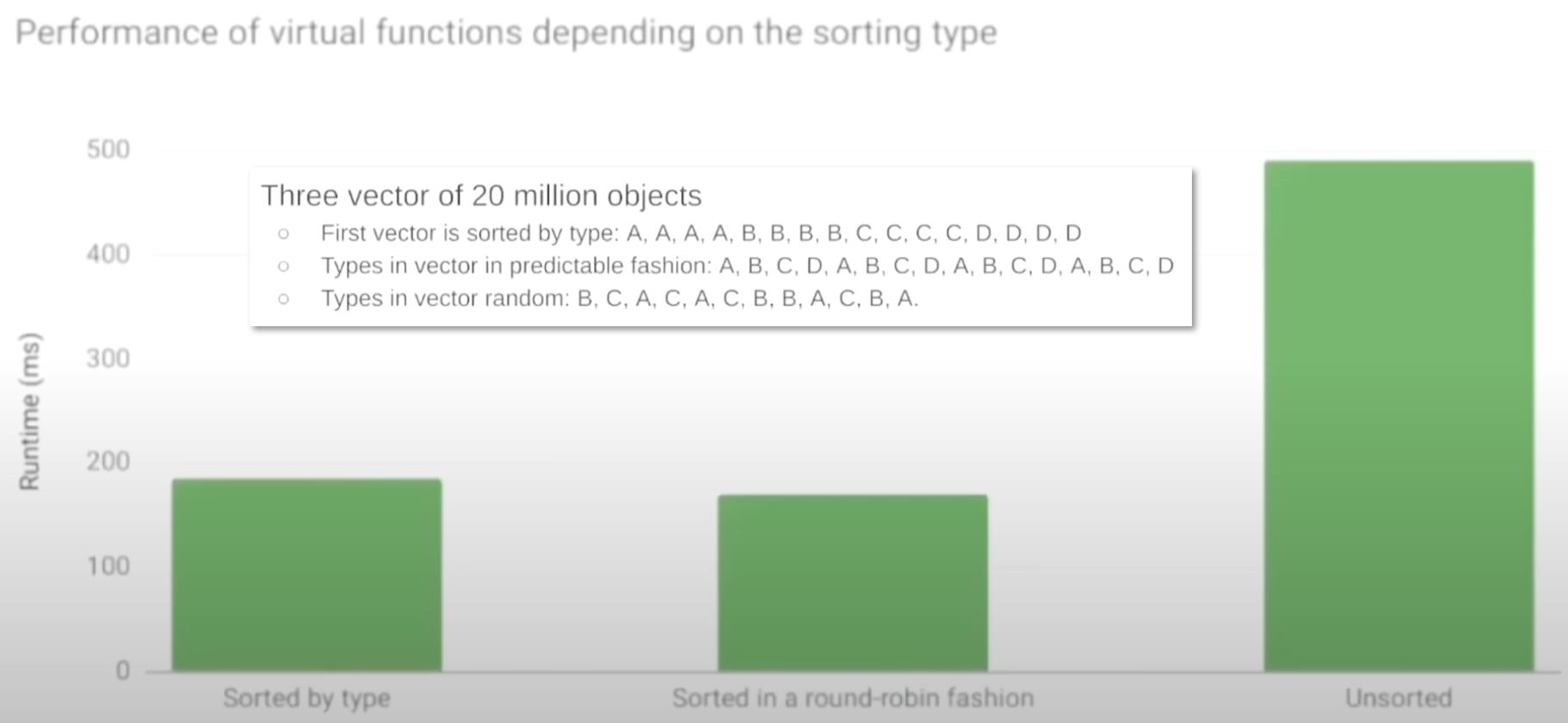
Type sorted in predictable manner: the CPU can successfully predict the address of the virtual function and this speeds up the computation
If types are appear randomly, the CPU cannot guess successfully and precious cycles are lost.
A solution to this is again, type based processing
(However, type based processing is not always usable)
The effect is mostly pronounced with short virtual functions
Issue 5: Instruction cache eviction
Modern CPUs rely on "getting to know" the instructions they are executing
The code that has already been executed is hot code
Its instructions are in the instruction cache
Its branch predictors know the outcome of the branch (true/false)
Its jump predictors know the target of the jump
The CPU is faster when executing hot code compared to executing code code
The CPU's memory is limited
The code that is currently hot will eventually become cold unless executed frequently
Virtual functions, especially large virtual functions where each object has a different virtual function, mean that we are switching from one implementation to another. So most of the time, it's likely to execute cold code.
Again, the phenomenon is not related to the virtual functions themselves, it will happen if each instance has a pointer to a different function.
However, it is most likely to occur with large virtual functions on mixed type unsorted vectors with many different derived types.
Conclusion
Virtual functions do not incur too much additional cost by themselves
It is the environment where they run which determines their speed.
The hardware craves predictability: same type, same function, neighboring virtual address
When this is true, the hardware run at its fastest
It's difficult to achieve this with casual usage of virtual function
:bulb: In game development, compared to OOP paradigm, they use another paradigm: data-oriented design (a.k.a entity component system). Check this book for more.
One of its major parts is type based processing: each vector holds one type only.
This eliminates all the problems related to virtual functions - however, it's not applicable everywhere.
:brain: If you need too use virtual functions, bear in mind:
The number one factor that is responsible for bad performance are data cache misses
Avoiding vector of pointers on a hot path is a must!
Other factors also play their role, but to a lesser extend
With careful design, you can reap most benefit of virtual functions without incurring too much additional cost
:bulb: Here are a few ideas to fix your code with virtual functions:
Arrangement of objects in memory is very important.
Try to make small functions non-virtual
Most overhead of virtual functions comes from small functions, they cost more to call than to execute
Try to keep objects in the vector sorted by type.
:bulb: Performance measurement tools: multitime, perf, likwid, other profilers...